
Mapeando o Conceito de Florescimento na Pesquisa em Saúde Mental: Uma Revisão de Escopo
- 24 fevereiro 2026
- 14:00
- Autora: Juliana Eschiavoni Barboza
Nas últimas décadas, a saúde tem incorporado uma perspectiva salutogênica, ampliando o foco da doença para a promoção da saúde e do bem-estar (Aaron Antonovsky, 1979). Nesse contexto, a psicologia positiva e a medicina do estilo de vida propõem intervenções voltadas a virtudes, valores, gratidão, resiliência, otimismo e espiritualidade, com evidências de redução de sintomas depressivos e ansiosos, além de melhora da qualidade de vida (Carr et al., 2021; Chakhssi et al., 2018). O conceito de florescimento possui raízes na eudaimonia aristotélica, entendida como um bem-estar vinculado à realização das potencialidades humanas. Assim, florescer envolve o cultivo de virtudes morais e intelectuais e uma vida orientada por ações éticas e comunitárias (Aristotle, 1984; Pinsent, 2013).
O crescimento de intervenções associadas ao florescimento e seus efeitos positivos na saúde mental tem impulsionado um avanço expressivo das pesquisas na área. Entretanto, a coexistência de múltiplos modelos contemporâneos colabora para a ausência de um consenso conceitual e de domínios claramente delimitados. Diante disso, o presente estudo o qual realizei como dissertação de meu mestrado pela Faculdade de Medicina da Universidade de São Paulo (FMUSP) teve como objetivo identificar definições e domínios utilizados na literatura científica em saúde mental.
https://papers.ssrn.com/sol3/papers.cfm?abstract_id=6265718
O estudo consistiu em uma revisão de escopo conduzida conforme a metodologia do Joanna Briggs Institute (Aromataris & Munn, 2020) e a extensão PRISMA-ScR (Tricco et al., 2018), empregando o framework para definição de: População (adultos), Conceito (flourishing) e Contexto (saúde mental). A busca foi realizada nas bases PubMed, Web of Science, Scopus, Biblioteca Virtual em Saúde – Brasil (BVS), APA PsycINFO, CINAHL e OpenGrey, sem restrições de data, através de uma estratégia booleana. Foram elegíveis estudos que abordaram o florescimento no campo da saúde mental, com participantes adultos (≥18 anos) e publicados em português, inglês, espanhol, italiano ou francês, sem restrição metodológica.
Foram excluídos estudos que utilizaram o termo “flourishing” em sentidos não relacionados à saúde mental (como economia ou agronomia), aqueles que não apresentaram uma definição conceitual clara, ou que não mencionaram explicitamente o termo. Os dados foram analisados por meio de análise temática (Braun & Clarke, 2006), análise descritiva com frequências absolutas e relativas, e mapeamento de coocorrências.
Foram identificados 4.862 estudos. Após triagem por título e resumo, foram excluídos 2.851 estudos. Ao final, 113 estudos atenderam aos critérios de inclusão. Os estudos que abordam florescimento em saúde mental foram publicados entre 2002 e 2024, sendo 37,2% entre 2023–2024. A predominância geográfica das amostras foi América do Norte (38,9%), seguida de Europa (38,1%), Oceania (8,8%), Ásia (8,8%) e África (5,3%). As definições de florescimento apresentadas nos artigos referenciaram 202 autores distintos, totalizando 528 menções ao conceito em diferentes seções dos estudos: resumo (23%), introdução (87,6%), métodos (17,7%), resultados (14,2%), discussão (35,4%) e conclusão (14,2%). Em média, cada artigo citou o conceito 4,5 vezes (desvio padrão = 3,64). De modo frequente, os autores combinaram diferentes referenciais teóricos ao definir o construto de florescimento.
A Figura 1 apresenta o florescimento como um construto dinâmico e multidimensional, ancorado em valores e virtudes, representando o polo positivo da saúde mental. Esse construto articula altos níveis de bem-estar e funcionamento ótimo com um processo contínuo de desenvolvimento humano. A síntese temática revelou cinco temas-chave inter-relacionados e mutuamente influentes: “Bem-Estar Completo”, “Ótimo Funcionamento”, “Valores & Virtudes”, “Saúde Mental Completa” e “Desenvolvimento Humano”. O florescimento é compreendido não como um estado estático, mas como um processo em evolução, marcado por avanços e retrocessos, moldado por experiências subjetivas e pelo contexto sociocultural. Cada tema apresentou subtemas específicos:
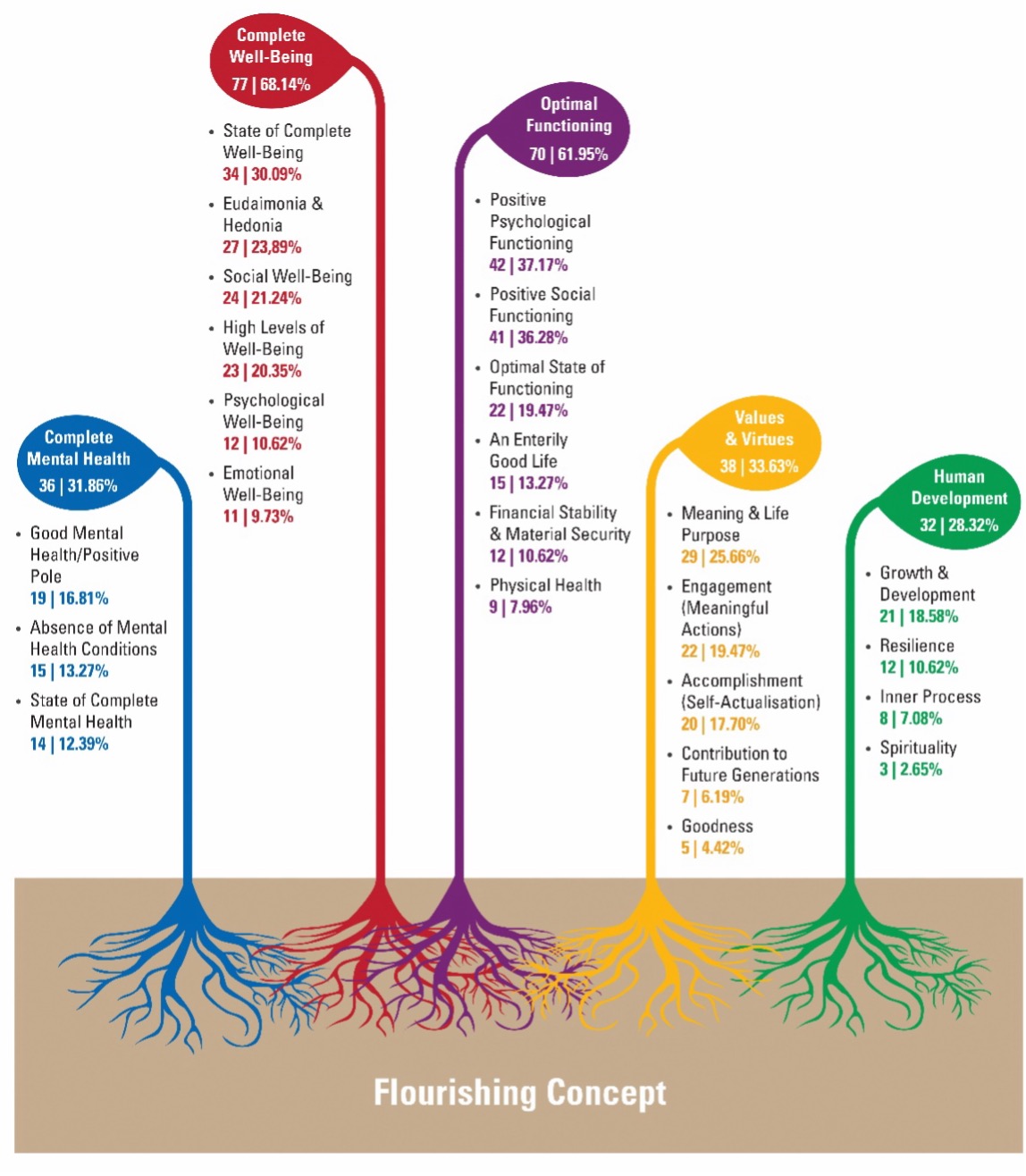
Figura 1 - Temas-chave do conceito de florescimento identificados por meio de análises temáticas
- “Bem-estar Completo” – Estado de equilíbrio psicológico, social e emocional, integrando dimensões hedônicas e eudaimônicas;
- “Ótimo Funcionamento” – Combinação de emoções positivas, propósito e satisfação de vida com estabilidade social e material;
- “Valores e Virtudes” – Associação de bem-estar individual e contribuição social, com foco em altruísmo, bondade e propósito; “
- Saúde Mental Completa” – Compreende o polo positivo da saúde mental, centrado em viver bem e não apenas sentir-se bem;
- “Desenvolvimento Humano” – Processo contínuo de crescimento pessoal, social e espiritual, baseado em resiliência e sentido de vida.
Identificamos cinco temas organizadores e 24 subtemas, evidenciando o florescimento como um constructo multidimensional, dinâmico e interconectado. O florescimento se configura como um conceito guarda-chuva, multidimensional e dinâmico, que integra vitalidade, sentido e crescimento pessoal. Os dados mostraram também a ausência de consenso teórico e a utilização simultânea de múltiplas referências e modelos conceituais. Apesar dessa heterogeneidade, as definições convergem amplamente para a compreensão do florescimento como boa saúde mental, altos níveis de bem-estar e funcionamento positivo, reforçando a natureza integrativa do conceito.
As análises temporais indicam variações na ênfase dos subtemas de flourishing ao longo dos anos, embora alguns temas tenham permanecido centrais. Até 2014, “Ótimo Funcionamento” predominava nas definições. Entre 2015 e 2018, “Bem-Estar Completo” ganhou destaque, enquanto “Valores & Virtudes” e “Saúde Mental Completa” tiveram expansão significativa após 2021. Observa-se uma ampliação do foco em “Bem-estar Completo”, com maior integração de múltiplas dimensões do bem-estar, e um deslocamento de “Ótimo Funcionamento” em direção ao funcionamento social positivo. O tema “Valores & Virtudes” passou a enfatizar mais o sentido e propósito de vida, enquanto “Saúde Mental Completa” tem sido descrito predominantemente em termos de saúde mental positiva. “Desenvolvimento Humano” tornou-se mais equilibrado entre seus subtemas, com maior destaque para espiritualidade e processos internos. Além disso, as descrições de flourishing frequentemente combinam “Ótimo Funcionamento” e “Valores & Virtudes”, e os padrões temporais sugerem uma transição de enfoques iniciais em virtudes, desenvolvimento humano e saúde mental para descrições mais recentes centradas em bem-estar completo e valores ao longo do tempo.
Além disso, observou-se uma evolução temporal nas descrições de florescimento, fortemente influenciada por autores-chave, com deslocamentos graduais na ênfase entre funcionamento ótimo, valores e virtudes, saúde mental e bem-estar completo. Esse dinamismo reforça a importância de clareza conceitual e discernimento na escolha de modelos teóricos e instrumentos de medida, especialmente em pesquisas empíricas, a fim de reduzir imprecisões e vieses.
Do ponto de vista da prática clínica e de políticas públicas, o estudo mostra que compreender o florescimento como um processo adaptativo e não rígido amplia as possibilidades de intervenções flexíveis e complementares voltadas à promoção da saúde mental e do bem-estar humano. Os achados evidenciam a necessidade de uma definição mais consensual e culturalmente sensível, capaz de fortalecer modelos teóricos, avanços filosóficos e práticas clínicas. A colaboração entre clínicos, pesquisadores e filósofos pode ampliar a robustez conceitual e metodológica em futuras investigações.
Referências
Aaron Antonovsky. (1979). Health, Stress, and Coping (Jossey‑bass, Ed.; 1st ed.).
Aristotle. (1984). The Complete Works of Aristotle. Vol. II: Revised Oxford Translation. (Jonathan Barnes (trans.), Ed.). Princeton University Press.
Aromataris, E., & Munn, Z. (Eds.). (2020). JBI Manual for Evidence Synthesis. JBI. https://doi.org/10.46658/JBIMES-20-01
Braun, V., & Clarke, V. (2006). Using thematic analysis in psychology. Qualitative Research in Psychology, 3(2), 77–101. https://doi.org/10.1191/1478088706qp063oa
Carr, A., Cullen, K., Keeney, C., Canning, C., Mooney, O., Chinseallaigh, E., & O’Dowd, A. (2021). Effectiveness of positive psychology interventions: a systematic review and meta-analysis. The Journal of Positive Psychology, 16(6), 749–769. https://doi.org/10.1080/17439760.2020.1818807
Chakhssi, F., Kraiss, J. T., Sommers-Spijkerman, M., & Bohlmeijer, E. T. (2018). The effect of positive psychology interventions on well-being and distress in clinical samples with psychiatric or somatic disorders: A systematic review and meta-analysis. BMC Psychiatry, 18(1). https://doi.org/10.1186/s12888-018-1739-2
Pinsent, A. (2013). The Second-Person Perspective in Aquina’s Ethics: Virtues and Gifts. Routledge.
Tricco, A. C., Lillie, E., Zarin, W., O’Brien, K. K., Colquhoun, H., Levac, D., Moher, D., Peters, M. D. J., Horsley, T., Weeks, L., Hempel, S., Akl, E. A., Chang, C., McGowan, J., Stewart, L., Hartling, L., Aldcroft, A., Wilson, M. G., Garritty, C., … Straus, S. E. (2018). PRISMA Extension for Scoping Reviews (PRISMA-ScR): Checklist and Explanation. Annals of Internal Medicine, 169(7), 467–473. https://doi.org/10.7326/M18-0850
Mapping the concept of flourishing in mental health research: A scoping review
Over recent decades, health has incorporated a salutogenic perspective, expanding its focus from disease to the promotion of health and well-being (Aaron Antonovsky, 1979). In this context, positive psychology and lifestyle medicine propose interventions centered on virtues, values, gratitude, resilience, optimism, and spirituality, with evidence of reduced depressive and anxiety symptoms, as well as improved quality of life (Carr et al., 2021; Chakhssi et al., 2018). The concept of flourishing has roots in Aristotelian eudaimonia, understood as a form of well-being linked to the realization of human potentialities. Thus, to flourish involves the cultivation of moral and intellectual virtues and a life guided by ethical and community-oriented actions (Aristotle, 1984; Pinsent, 2013).
The growth of interventions associated with flourishing and their positive effects on mental health has driven a significant advancement in research in the field. However, the coexistence of multiple contemporary models contributes to the absence of a conceptual consensus and clearly defined domains. Therefore, the present study—which I conducted as my Master’s dissertation at the School of Medicine of the University of São Paulo (FMUSP)—aimed to identify definitions and domains used in the scientific literature on mental health.
https://papers.ssrn.com/sol3/papers.cfm?abstract_id=6265718
The study consisted of a scoping review conducted according to the methodology of the Joanna Briggs Institute (Aromataris & Munn, 2020) and the PRISMA-ScR extension (Tricco et al., 2018), using the framework for defining Population (adults), Concept (flourishing), and Context (mental health). The search was performed in the PubMed, Web of Science, Scopus, Biblioteca Virtual em Saúde – Brazil (BVS), APA PsycINFO, CINAHL, and OpenGrey databases, with no date restrictions, using a Boolean strategy. Eligible studies addressed flourishing in the field of mental health, with adult participants (≥18 years), and were published in Portuguese, English, Spanish, Italian, or French, with no methodological restrictions.
Studies that used the term “flourishing” in meanings unrelated to mental health (such as economics or agronomy), those that did not present a clear conceptual definition, or those that did not explicitly mention the term were excluded. Data were analyzed using thematic analysis (Braun & Clarke, 2006), descriptive analysis with absolute and relative frequencies, and co-occurrence mapping.
A total of 4,862 studies were identified. After title and abstract screening, 2,851 studies were excluded. In the end, 113 studies met the inclusion criteria. Studies addressing flourishing in mental health were published between 2002 and 2024, with 37.2% published between 2023–2024. The geographical predominance of samples was North America (38.9%), followed by Europe (38.1%), Oceania (8.8%), Asia (8.8%), and Africa (5.3%). The definitions of flourishing presented in the articles referenced 202 distinct authors, totaling 528 mentions of the concept across different sections of the studies: abstract (23%), introduction (87.6%), methods (17.7%), results (14.2%), discussion (35.4%), and conclusion (14.2%). On average, each article cited the concept 4.5 times (standard deviation = 3.64). Frequently, authors combined different theoretical frameworks when defining the construct of flourishing.
Figure 1 presents flourishing as a dynamic and multidimensional construct, anchored in values and virtues, representing the positive pole of mental health. This construct articulates high levels of well-being and optimal functioning with a continuous process of human development. The thematic synthesis revealed five interrelated and mutually influential key themes: “Complete Well-Being,” “Optimal Functioning,” “Values & Virtues,” “Complete Mental Health,” and “Human Development.” Flourishing is understood not as a static state, but as an evolving process, marked by advances and setbacks, shaped by subjective experiences and by the sociocultural context. Each theme presented specific subthemes:
Figure 1 – Key themes of the flourishing concept identified through thematic analyses.
- “Complete Well-Being” – A state of psychological, social, and emotional balance, integrating hedonic and eudaimonic dimensions;
- “Optimal Functioning” – A combination of positive emotions, purpose, and life satisfaction, together with social and material stability;
- “Values & Virtues” – The association between individual well-being and social contribution, with emphasis on altruism, kindness, and purpose;
- “Complete Mental Health” – The positive pole of mental health, centered on living well rather than merely feeling well;
- “Human Development” – A continuous process of personal, social, and spiritual growth grounded in resilience and meaning in life.
We identified five organizing themes and 24 subthemes, highlighting flourishing as a multidimensional, dynamic, and interconnected construct. Flourishing emerges as an umbrella, multidimensional, and dynamic concept that integrates vitality, meaning, and personal growth. The data also revealed a lack of theoretical consensus and the simultaneous use of multiple references and conceptual models. Despite this heterogeneity, the definitions broadly converge toward understanding flourishing as good mental health, high levels of well-being, and positive functioning, reinforcing the integrative nature of the concept.
Temporal analyses indicate variations in the emphasis of flourishing subthemes over the years, although some themes have remained central. Until 2014, “Optimal Functioning” predominated in definitions. Between 2015 and 2018, “Complete Well-Being” gained prominence, while “Values & Virtues” and “Complete Mental Health” expanded significantly after 2021. There is an observable broadening of the focus on “Complete Well-Being,” with greater integration of multiple dimensions of well-being, and a shift within “Optimal Functioning” toward positive social functioning. The “Values & Virtues” theme has increasingly emphasized meaning and life purpose, whereas “Complete Mental Health” has been predominantly described in terms of positive mental health. “Human Development” has become more balanced across its subthemes, with increased emphasis on spirituality and internal processes. Furthermore, flourishing descriptions often combine “Optimal Functioning” and “Values & Virtues,” and temporal patterns suggest a transition from early emphases on virtues, human development, and mental health to more recent descriptions centered on complete well-being and values over time.
In addition, a temporal evolution was observed in the descriptions of flourishing, strongly influenced by key authors, with gradual shifts in emphasis among optimal functioning, values and virtues, mental health, and complete well-being. This dynamism reinforces the importance of conceptual clarity and careful selection of theoretical models and measurement instruments, especially in empirical research, in order to reduce inaccuracies and biases.
From the perspective of clinical practice and public policy, the study shows that understanding flourishing as an adaptive rather than rigid process broadens the possibilities for flexible and complementary interventions aimed at promoting mental health and human well-being. The findings highlight the need for a more consensual and culturally sensitive definition capable of strengthening theoretical models, philosophical advances, and clinical practices. Collaboration among clinicians, researchers, and philosophers may enhance conceptual and methodological robustness in future investigations.
References
Aaron Antonovsky. (1979). Health, Stress, and Coping (Jossey‑bass, Ed.; 1st ed.).
Aristotle. (1984). The Complete Works of Aristotle. Vol. II: Revised Oxford Translation. (Jonathan Barnes (trans.), Ed.). Princeton University Press. .
Aromataris, E., & Munn, Z. (Eds.). (2020). JBI Manual for Evidence Synthesis. JBI. https://doi.org/10.46658/JBIMES-20-01
Braun, V., & Clarke, V. (2006). Using thematic analysis in psychology. Qualitative Research in Psychology, 3(2), 77–101. https://doi.org/10.1191/1478088706qp063oa
Carr, A., Cullen, K., Keeney, C., Canning, C., Mooney, O., Chinseallaigh, E., & O’Dowd, A. (2021). Effectiveness of positive psychology interventions: a systematic review and meta-analysis. The Journal of Positive Psychology, 16(6), 749–769. https://doi.org/10.1080/17439760.2020.1818807
Chakhssi, F., Kraiss, J. T., Sommers-Spijkerman, M., & Bohlmeijer, E. T. (2018). The effect of positive psychology interventions on well-being and distress in clinical samples with psychiatric or somatic disorders: A systematic review and meta-analysis. BMC Psychiatry, 18(1). https://doi.org/10.1186/s12888-018-1739-2
Pinsent, A. (2013). The Second-Person Perspective in Aquina’s Ethics: Virtues and Gifts. Routledge.
Tricco, A. C., Lillie, E., Zarin, W., O’Brien, K. K., Colquhoun, H., Levac, D., Moher, D., Peters, M. D. J., Horsley, T., Weeks, L., Hempel, S., Akl, E. A., Chang, C., McGowan, J., Stewart, L., Hartling, L., Aldcroft, A., Wilson, M. G., Garritty, C., … Straus, S. E. (2018). PRISMA Extension for Scoping Reviews (PRISMA-ScR): Checklist and Explanation. Annals of Internal Medicine, 169(7), 467–473. https://doi.org/10.7326/M18-0850